Coquinas Again?

Well I have to say I’ve been a little surprised how many searches for “coquina recipe” I’ve seen on my site stats. With that in mind, and given that we’re at the beach again, I figured: why not share another coquina experiment?

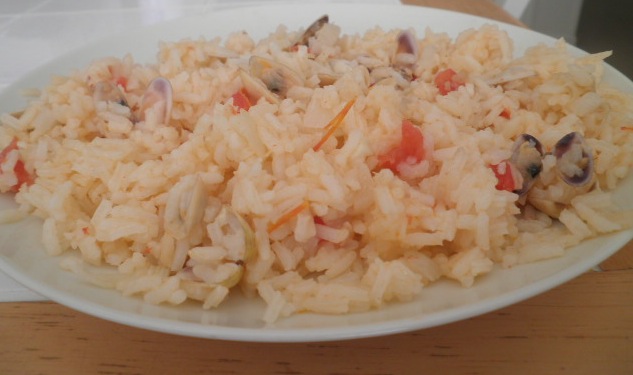
For this dish, I’ve divided the coquinas by size: you will need two cups of coquinas in total, but sort out and reserve about a quarter cup of the largest and most colorful ones you can find (see Warning! below). The smaller coquinas are used for your broth, and the larger ones will go directly into the rice.

The Broth:

1-3/4 cups of live coquinas–cleaned, rinsed, & sorted
1 teaspoon olive oil
1 clove garlic, minced
1 teaspoon salt
4 cups water

In a sauce pan, heat the olive oil. Add the garlic and saute quickly. Add the coquinas, salt, and water bring to just below a boil, then simmer for at least twenty minutes. Strain and set aside.

The Rice:

1/4 cup of large, live coquinas (cleaned, rinsed & sorted)
1 tablespoon olive oil
1 large tomato, diced
1 small onion, diced
1 clove garlic, minced
1-1/2 cups of white rice (I prefer valencia to long grain)
3 cups (or so) of coquina broth

Heat the oil in a frying pan over a medium heat. Add the rice, stirring to coat each grain of rice with oil. Saute for about a minute, then add the minced garlic, diced onions and diced tomato. Saute for another minute or so, then add the large coquinas and enough of the coquina broth to cover the rice. Lower the heat to a simmer and cover the frying pan. Continue to add the coquina broth about a half cup at a time–if possible, without stirring. You aren’t really making a risotto here, but you’re using a similar technique.

When the rice is tender, transfer to a serving dish. Now here’s the warning.

Warning! The only problem I see with this dish is that biting down on a coquina shell could be hazardous to your teeth. When I served this dish up, I made sure to plate it in such a way that the coquinas were visible in the rice. Using the largest coquinas you can find, and the most brilliantly colored, will make it a little easier to see those little critters. Still, I strongly recommend you eat this dish with care.

Posted in Uncategorized | Tagged , , , | Leave a comment

(Grilled) Meat on a Stick

OK, Summertime is officially here so it’s time to grill, right?

Maybe you busted out your hibachi for the first time on Memorial Day, but one of the nicest things about living in the south is having month after month of weather warm enough for outdoor cooking. Things definitely pick up a bit once the kids get out of school, though. We do standard grillfare pretty regularly–burgers, steaks, and assorted sausages. As of late, though, kabobs have become our go-to grill choice if we’re doing chicken.

Somewhere along the line I fell in love with the concept of brining chicken breasts. I pretty much avoid using chicken breast for anything other than cutlets, but if I am going to grill white meat, I always brine it to keep it moist and tasty. I use a “Brine of 4’s” because it’s easy for me to remember:

4 cups of water
1/4 cup of sea salt
1/4 cup of brown sugar
4 tsp of seasoning

For kabobs, I use 3 tsp of cumin and 1 tsp of garlic powder, but I have used this same brine with lots of spice profiles for lots of other dishes.

The volume here is enough to completely submerge 3 or 4 chicken breasts.You will want to brine the chicken for at least an hour. Since I skewer up small pieces of chicken, I cut them before I brine them to increase surface area (and hence flavor).

The great thing about kabobs is that you can work out multiple permutations of what ends up on everybody’s plate pretty easily. A nice little trick that I picked up from Good Eats: skewer your items separately (red peppers on one stick, onion on another, chicken on a third, etc.) so that you can have more control over doneness of each item.

For a side, we always go with bulgur wheat.

Posted in Uncategorized | Tagged , , , | Leave a comment

Cook, Where’s My Hasenpfeffer?

So we all know the Bugs Bunny episode, right?

Our hasenpfeffer dinner started as a running joke with Josh’s older brother. For years now, I have been telling Matthew that I would make hasenpfeffer for his birthday dinner. Why? Well, mostly because it’s fun to say, and partly because when Matthew discovered that hasenpfeffer was rabbit–and that his mother was dubious about cooking Peter Cottontail–it became all the more of an intriguing meal for him. This year and last, we were intent on actually making the dish, but finding rabbit when you want it isn’t always that easy. It’s not impossible to get rabbit in Atlanta (more on that below), but our full service butcher seemed to have them only in late winter/early spring. By the time Matthew’s birthday would roll around, all of Atlanta’s rabbits would seem to have scampered away. So much for late March Hares.

But this year–success. Or partial success, at least.  As the old rabbit recipe saying goes: “First, catch your hare.” Be forewarned: when buying a frozen rabbit, ask from whence your rabbit came–you may, in fact, be purchasing 兔子. When I picked up my rabbit at an intown market with a butcher shop known for its snout-to-tail offerings, I had assumed the rabbit would have been locally sourced. Not quite. Don’t get me wrong–there was nothing wrong with the Chinese import, but given the choice, I would prefer meat that hasn’t traveled from quite literally the other side of the world. The next time I make up rabbit, I will search a little harder (and a little more carefully) and buy local product.

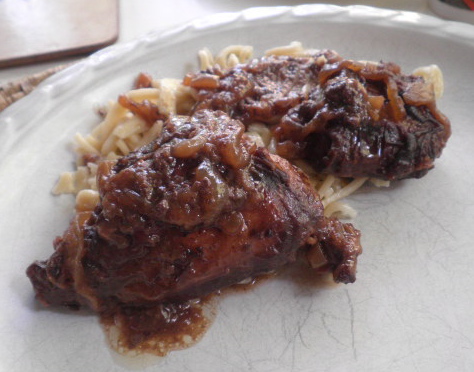
As odd as the name is, hasenpfeffer is not really a very complicated dish to prepare. It does require planning, however, since you will need to marinade your rabbit for a good 48 hours. The recipe below draws off of my 1973 paperback edition of The Joy of Cooking, which also has a nice section on cleaning and preparing squirrel. I’ve modified the marinade considerably, but the simple approach of the Joy of Cooking recipe struck me as the most appealing version I could find.

The Marinade

2 tbs olive oil
2-3 stalks of celery w/tops, chopped
2 carrots, chopped
1 medium onion, chopped
1 tsp salt
1/2 tsp of whole black peppercorns
1/2 tsp of whole allspice
1/2 tsp of whole cloves
1/2 tsp of black mustard seeds
1-2 cloves garlic
3 bay leaves
2 cups red wine
1/2 cup red wine vinegar

The Rest of the Dish

1 rabbit, around 2-1/2 lbs
2 tbs each of bacon drippings and canola oil
flour, for dredging
1 medium onion, cut in thin slices
1/2 tsp salt

Heat the olive oil in a deep pot. Once hot, add the roughly chopped celery, onion, and carrots. Add the salt and saute until the onions start to sweat, then add the remainder of the marinade ingredients except for the liquid. Saute another 3-4 minutes. Add the wine and the vinegar and heat until the mixture is just under a boil. Lower and simmer for another half hour. Let the mixture cool to room temperature, and then strain into a glass bowl.

Wash (and if necessary, clean) your rabbit and pat dry. Cut up your rabbit into 9 pieces: divide the rear legs at the joints, but keep the front legs intact. Divide the body into three evenly sized pieces. Once your marinade has reached room temperature, submerge the rabbit in the marinade, cover with plastic wrap, and refrigerate for two days (rotate the meat after day one to ensure everything is well marinaded).

After two days soaking in red wine and vinegar, your rabbit will look…well, purple. Not to worry. Things are going to get nice and brown really soon. Remove the rabbit from the marinade and pat dry. Set aside your marinade.

Preheat your oven to 350 degrees. In a large, stainless steel frying pan, heat up your bacon drippings and your canola oil. Dredge each rabbit piece in flour, shaking off any excess. When your oil is hot, brown each piece on both sides. You should not crowd the pan, but given the size of a 2-1/2 lb rabbit, you could probably brown all the pieces in one go.

When you are finished browning the meat, remove to a deep casserole dish. Add the sliced onions and about a 1/2 teaspoon of salt to the frying pan. Cook on medium for several minutes, scraping up as much of that lovely, brown goodness as you can. When the onions have started to soften and pick up a good color, add the marinade and raise the heat to high. Deglaze the pan and keep on high until the liquid begins to boil. Leave at a boil for two or three minutes.

Transfer the liquid and the cooked onions to the casserole dish. Cover and cook in the oven for an hour and a half. Serve over dumpling noodles or spaetzle.

After Matthew’s first bite, his comment to me was: “We are definitely having this again next year.” Maybe with a little effort, we can actually have it in the same month as his birthday. No surprise that Josh approved of the dish–or even that little sister liked the little that she tasted. The big surprise: the kids even managed to convert their mom!

And did I mention how low in cholesterol rabbit is? Yes, even cooked in bacon drippings.

Posted in Uncategorized | Tagged , , , | 3 Comments

Schnitzel!

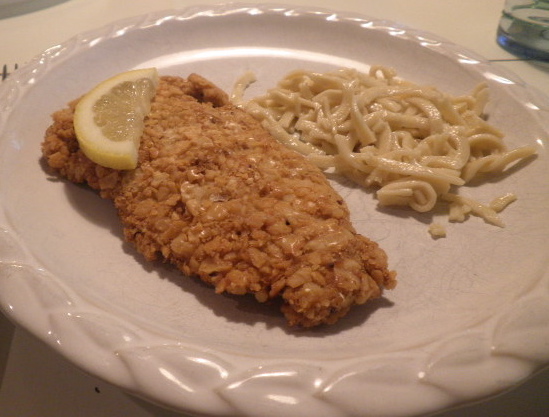
OK, I can’t really explain my strange obsession with schnitzel. I have no German or Austrian heritage, but lately this tasty little treat has made it into a fairly regular rotation in our household. Granted, breading and frying anything is usually a good idea, but lately I’ve been more interested in a cracker-encrusted pork loin escalope over something closer to the chicken or beef cotoletta of my Italian roots.

But before I go on, a note to traditionalists: it’s not as though I haven’t consistently called a dish by the wrong name in the past, but technically it’s not wiener schnitzel that I’ve been making since I don’t use veal. That said: I’ve certainly seen and heard pork loin schnitzel called by that name, so call it what you will–and enjoy.

1-1/4 lb pork loin
6 matzos
1 cup flour
2 eggs
salt
fresh ground pepper
1 lemon

Slice the pork loin into five 1/4 lb chops. Place each chop between two sheets of plastic wrap and pound into escalopes with a mallet. Without question: this is Josh’s favorite part of the recipe. Set aside your escalopes while you prepare your dredge.

Set up a dredging station with flour, beaten eggs, and crushed matzos. Often when I make cutlets, I do not add any salt or pepper to the egg. For this dish, I think it’s essential–I hit it with about 1/2 tsp of salt and a few grinds of black pepper. For the matzos, I crush them pretty well, but I definitely like to keep some of the cracker texture. Ideally, you will want a nice mix of finely pulverized matzo and bigger pieces. Dredge each escalope through the flour (knock off anything that doesn’t stick to the pork), then the egg, and finally the matzo crumbs. Let the breaded escalopes sit in the fridge for at least a half hour.

When you are ready to fry, heat up a 1/4 inch of oil in a heavy bottom pan. If we were going for authentic, I’d be using lard. I have used a mix of butter and oil, but more often than not I just use canola oil. When your oil is hot, fry a couple of schnitzels at a time (don’t crowd the pan) to a golden brown. Transfer to paper towel and season with a pinch more of salt.

As you plate the schnitzel, garnish with a lemon slice. The lemon really is essential–a little wipe of a lemon slice really brings out the flavor.

In the past I have usually served this dish with mashed potatoes, but last night I used dumpling noodles as a side, tossed in butter. I’m now sold on it as the perfect side. For a veg: cabbage sauteed with bacon, pickled green beans, and broccoli have all made guest appearances at one time or another. On this night, it was simple green salad.

Posted in Uncategorized | Tagged , , , | 2 Comments

Hellish Relish

Back after a long hiatus, and with another culinary experiment.

The following was inspired by watching one too many “hot challenges” on  Man vs. Food while trying to think of a way to liven up our Sunday night grilled burgers. What I came up with was a little condiment that Josh and I nicknamed “hellish.”

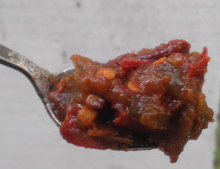
Truth be told: Josh is more a fan of the idea of this topping than the condiment itself. He taste-tested some off of the tip of a teaspoon, and this hellish relish definitely exceeds his Scoville limit.

3/4 cup diced pickled jalapenos
7 oz. can of chipotle peppers in adobo sauce, diced
1/2 teaspoon (more or less to taste) of intense pepper sauce

First things first: you are going to be heating up hot peppers, so if you are super-sensitive to  capsaicin (and if you are, why on earth are you making this stuff!) make sure you have a hood vent going, and try to avoid getting vapors in your eyes or up your nose.

Now, on to the cooking: Heat a small frying pan over a medium flame. Place the diced, pickled jalapenos in the dry, hot frying pan and saute for about two minutes. Next, add the diced chipotle peppers, plus the adobo sauce from the can. Simmer for another two or three minutes until the mixture starts to thicken. Shut off the heat and add your “intense” pepper sauce. Whatever you have in the house will work, but I would recommend something with a little habanero kick to it. I’ve had a bottle of Dave’s Insanity Sauce in my fridge for a while now–a little does indeed go a long way. The extra heat and the sharper bite of the sauce is a nice counterpoint to the smoky chipotle and the vinegary pickled jalapenos.

After adding in the pepper sauce, let the mixture cool to room temperature. Transfer to a plastic, non-staining container, and you are ready for some tasty heat.

This is a hot topping no doubt, but not so hot that it kills your palate. I could see “hellish” spicing up a number of dishes, but I think its original destination is probably the best–as a topping on burgers. I ladled out a nice, heaping teaspoon (or two) on top of a double-stacked Monterey Jack cheeseburger, and it was pretty awesome. I hope you’ll agree!

Posted in Uncategorized | Tagged , , , , | 4 Comments

Coquina Broth

We have been at the beach this week. It’s been cool in the days and windy at night–and I haven’t caught a single fish. We are usually down here on the Gulf when the water is warmer and can pretty much count on a lunch’s worth of whiting, and with any luck, flounder, black drum, redfish, and the occasional pompano (if our timing is right).

And of course, Fish Head soup.  But on this trip: nothing. And how can you make fishhead soup if you haven’t caught a single fish?

That’s when Josh got the idea to make coquina broth.

The night before, he had been looking through a shell book with his grandmother, trying to identify what turned out to be a fighting conch shell. Flipping through the pages, he stumbled upon a full-page spread on coquina, with a sidebar describing coquina broth. It wasn’t much of a recipe–something along the lines of: rinse the coquina, pick out the dead ones, and boil. He couldn’t wait to show it to me.

There’s a back story here–Josh had asked me last year about coquinas, wondering if it were possible to use them in a chowder. I expressed my doubts. Now here was proof-positive that someone, somewhere had deemed these little critters foodworthy.

So, what’s a coquina? They are these tiny bivalves, about an inch long and a quarter inch wide. They have beautiful shells tinged blue, purple, pink, or yellow. They are fast diggers (I leave you to search YouTube for proof). And, apparently, they make a very yummy broth.

      2 cups of coquinas–cleaned, rinsed, and sorted (the live ones only!)
      1 tablespoon olive oil
      2 cloves garlic, minced
      1 cup chopped tomato
      1 teaspoon salt
      5 cups water

    Heat your olive oil and add your garlic. Saute for a few seconds, then add your tomato and salt. Cook for a couple of minutes until the tomatoes start to break down. Add the coquinas and simmer until the shells start to open. Add water and raise the heat to high. Once your liquid gets close to a boil, lower your heat and simmer for 20 minutes.

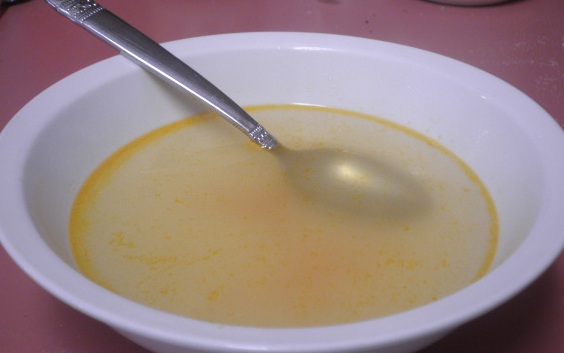
    Strain and serve.

    There’s really not much meat inside those shells. We all tried a nibble and none of us thought much of trying to make a meal of those morsels. The broth, however–that’s a different story. There’s a surprising amount of flavor packed in those little fellas.

    I can’t imagine any of you running out to make this dish (can you buy coquina?) but hey–next time you’re playing in the sand…who knows? Maybe a cup of coquina broth isn’t your thing, but I could definitely see using this stuff as a very tasty base for a pasta or rice dish. Plus, any meal that the kids can see go from ocean to table is a good one in my book.

Posted in Uncategorized | Tagged , , | 9 Comments

Carne Asada Tacos

When I say tacos, do you think crunchy yellow shells, shredded lettuce, and cheddar cheese? Not me.

Honestly, I was never a big fan of tacos as a kid because that was the stuff I grew up on–The #7 Combo Tex-Mex style tacos, or home-prepared out-of-the-box shells with ground beef cooked in “taco seasoning” (whatever that stuff is).

Then I went to my first taqueria and had Mexican-style tacos. Now I am a changed man.

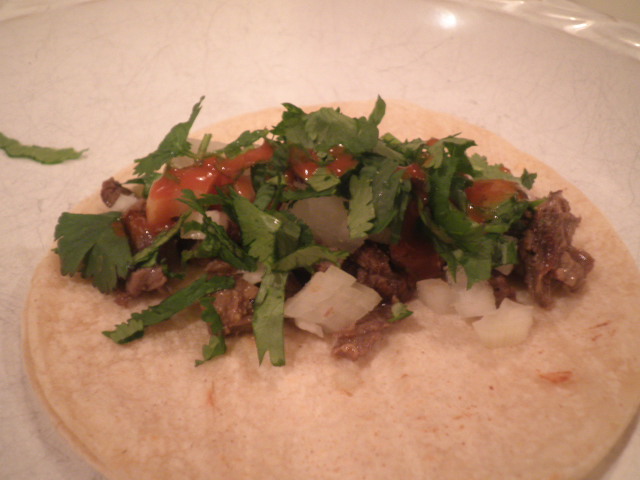
We are a soft taco household now. If we want crunchy tortillas, we’ll make tostadas. But if it’s tacos, it’s gotta be soft. And corn. I am super-simple in my tastes too–just cilantro, onion, a squeeze of lime, and a squirt of salsa picante. Josh dresses things up a bit more with a little queso fresco, crema, and maybe even some diced tomato.

Tacos are in a fairly heavy rotation in our household because it’s (yet another) great way to use up leftovers. More often than not I’m doing carne asada, but I have also improvised tacos al pastor with leftover pork chops.

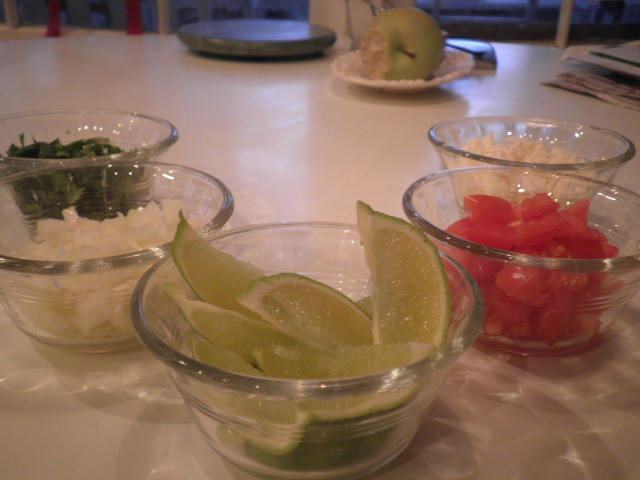
This is a real quick prep, so I usually get my fixings to table  before I start on the meat:

    2 fresh limes, cut in 6 slices each
    1 small onion, diced
    1 cup cilantro leaves, chopped
    1/2 cup diced tomatoes
    1/2 cup crumbled queso fresco
    1/2 cup Mexican crema
    1 bottle (OK, maybe not the whole bottle) salsa picante–or, if you prefer, salsa verde

Place each of the fixings into its own bowl or container and bring it to the table. Now you’re ready to get started on the tortillas and the meat.

    3/4 lb leftover steak, cut into thin, bite-size morsels
    1 tablespoon olive oil
    1 teaspoon adobo seasoning
    1 teaspoon salsa picante
    1 lime, cut in half
    11-16 white corn torillas (see note below)

Get a cast iron pan good and hot. I have a little flapjack griddle that I inherited from my wife’s grandmother that’s perfect for this. When your iron is hot, start warming the tortillas one at a time. You want to heat each side for a couple of minutes, but not much longer (you don’t want any browning). Transfer the tortilla to a tea towel, and then fold the towel around it. Keep warming your tortillas one at a time as you work on your meat, stacking them and wrapping them inside the tea towel.

Now about the meat: just like what I’ve said about meatballs–there’s a certain charm and pleasure to be had in foods of poverty and scarcity. You probably could find a better use for leftover filet mignon. For us, it’s usually a flatiron or a skirt steak. And 3/4 of a lb is plenty for this family. A good taco, in my reckoning, is a well-balanced taco.

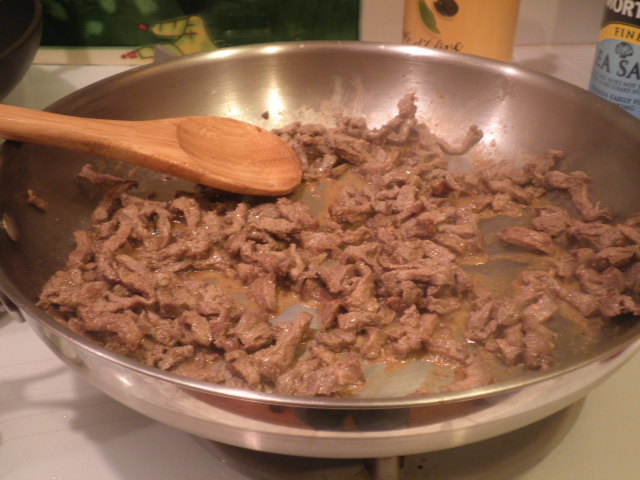
In a heavy bottomed frying pan, heat the olive oil over a medium flame. Add the chopped steak, salsa picante, and adobo seasoning. cook for several minutes until most of your liquid has reduced. Now squeeze the lime juice over the meat, mix, and cook for another minute or two. Remove the meat to a serving dish and bring it to the table.

Now construct your tacos as you see fit. NOTE: I usually prepare 16 torillas, but that doesn’t yield 16 tacos. My preference is to double up on the tortillas–two per taco. As seems to be the case with most things in the house, we’re about equally divided on the single vs. double tortilla controversy.

In our household, 16 tortillas will end up making 11 tacos, which is enough for this family of five.

Posted in Uncategorized | Tagged , , , , | 2 Comments

Breakfast for Dessert (or Vice Versa)

Just a quick little post here about kesari. I guess I’m on a bit of an Indian theme lately….

Back in 2005, I spent three weeks touring India. Several times on that journey, I encountered a ridiculously sweet and ridiculously delicious dessert. It was as thick as a porridge, buttery smooth, and thoroughly spiced with cardamon. Just about every place I found this dish, it had plump raisins mixed in, and about half the time cashews or some other kind of nut as well.

The dish, it turns out, is called kesari; traditionally, it is made from rava, or farina wheat. If you are looking for rava at your local supermarket, take a stroll down your breakfast cereal aisle. Any brand of that creamy, hot wheat cereal will do just fine.

I played around with this recipe a few times: sometimes adding saffron, sometimes not; sometimes using pistachios, sometimes no nuts at all. Whatever version you try, though, be forewarned. This is not a dessert to eat in big batches! A small portion goes a long way.

So, why am I telling you about kesari this morning? Because I’ve just submitted my very first “Food52” contest recipe. It’s a variation on kesari–vanilla extract in place of cardamon, and egg yolks instead of all that butter. It’s a nice dish; still quite sweet, but not so heavy. If you want to see the recipe, you can find it listed in the Book 2 Week 26 contest.

Oh, and while you’re there, feel free to “like” it, ok?

Posted in Uncategorized | Tagged , , , | 2 Comments

Masala Chai

I am the first up in the house on weekday mornings. It took me a while to realize it, but I actually like that half hour or so before anyone else is awake. I’m on auto-pilot to some degree–working out what to pull together for lunches, and what to whip up for breakfast. Still, it’s my time in the house, and I enjoy those moments of quiet and calm.

On winter mornings, more often than not breakfast includes a warm beverage. Sometimes it’s just a simple pot of tea, or maybe some Mexican-style hot cocoa. But if I have a few extra moments (or if it’s one of those extra gray winter mornings), I will brew up some masala chai. Honestly, I have no idea how “authentic” my version is, but as far as anyone in my house is concerned, this is the way masala chai is supposed to taste.

It’s pretty much a draw for Josh which hot beverage he prefers–the Mexican hot cocoa or masala chai. For me, hands down I’ll take the masala chai.

Here’s my version:

    3 cups water
    2 cups milk (whole, if you have it)
    2 teabags of black tea
    <1/8 teaspoon clove
    <1/8 teaspoon nutmeg
    1/4 teaspoon ground cardamon
    2-3 tablespoons sugar, depending on your taste
    2 cinnamon sticks

Place all ingredients into a saucepan and heat over a medium flame. Once you start to see steam rising from the pot, lower to a simmer. This is definitely  a place to play with spices–I avoid ginger, for example, based on my kids’ preference. It’s important, though, that the cardamon dominates in your ratios. I also think it’s important to use cinnamon sticks instead of ground cinnamon. There’s a more full, rounded taste in the sticks, in my opinion.

I’ve never bothered timing out how long I leave the masala chai on simmer. I just go about fixing breakfast and making lunches, then pour the tea last. I would say at a minimum let it simmer for 10-15 minutes.

The kids like a smooth tea, so I always take the extra step of straining the mixture through a fine mesh filter before serving (such as a reusable coffee filter).

Boy, writing this up sure made me thirsty. And it is looking rather gray out there this morning….

Posted in Uncategorized | Tagged , , , | Leave a comment

Josh and his Dad Experiment: Swamp Cookies

First, a disclaimer: These cookies are, well, a little weird.

Second, a little background:

I have a problem: I get my dried herbs and spices really cheaply. Our farmer’s market sells bulk herbs and spices, which means I get four ounces of ground ginger for 60 cents. The problem is: I have huge amounts of lesser-used spices piling up on my shelves. Sure, I can use up four ounces of thyme in no time (sorry, couldn’t resist) but file powder? Just how much gumbo can one family eat?

So that’s what motivated me to try to think of something different to do with file powder–why not cookies, right? OK, I agree it sounds a little strange, but why not experiment?

Our first step was to come up with a flavor profile for the cookies. I set up a big cutting board with three little piles of file powder, then added clove to the first, ginger to the second, and clove and ginger to the third. Next, I put down two piles of sugar: one white and one dark brown. Finally, I dolloped out a tablespoon each of molasses and honey.

Next step: Josh and I start the taste tests. Round One eliminated ginger x file from the running. Too spicy. That left us with:

clove x file vs. ginger & clove x file

Next, we tried each sugar with each spice/file mixture to arrive at our semi-finalists. The winning combos were:

clove & file x brown sugar vs. clove, ginger & file x white sugar.

Final Round: pairing each of these mixtures with molasses and honey. The winning combination was:

clove, file, brown sugar, and molasses

For the cookie dough, I worked off of a variation of a snickerdoodle recipe. Here’s what we came up with:

    1-1/2 sticks of butter, softened
    1-1/2 cups brown sugar
    1 egg
    2 tablespoons molasses
    2-1/2 cups flour
    1 teaspoon baking soda
    1/2 teaspoon salt
    1-1/4 teaspoons clove
    1-1/4 teaspoons file powder

Whip the butter and sugar until airy. Add the egg and beat. Add the molasses and combine until smooth.

Mix together your dry ingredients, then add to your wet, combining with a wooden spoon or spatula. Once you have a dough (it will be pretty wet, given the butter/sugar ratio here), form a ball and wrap in plastic. Place in the fridge for at least 45 minutes.

Preheat your oven to 350 degrees. Once your dough has set up, slice off pieces and roll into 1″ balls. Place the balls on a cookie sheet lined with parchment paper, with about 3″ between them. Flatten to just under 1/2″ by pushing down (criss-cross) on the balls with a fork twice. Back for 13-14 minutes.

Let them cool for a couple of minutes before transferring them off the parchment paper and onto a cooling rack.

The verdict? Think spice cookies, but with an unusual undertone. Odd, perhaps, but not at all unpleasant. At least that was the majority opinion. Josh and my youngest (age five) both liked the cookies. My ten year’s comment: “Tastes like chicken.” Which got me to thinking of another experiment: why not use the same flavor profile for a sausage-cornbread stuffing? Hmm…

So were Swamp Cookies a success? Given how much fun Josh and I had experimenting in the kitchen, I would say most definitely.

Posted in Uncategorized | Tagged , , , | 7 Comments